Counterfeit medicines prevention is one of the most urgent challenges facing hospitals, pharmacies, and distributors across Africa today. Substandard and falsified medicines put patients at direct risk, and every point in the supply chain is either a weak spot counterfeiters can exploit or a firewall that keeps them out. The good news is that counterfeit products overwhelmingly enter through informal, undocumented channels. A disciplined, verified supply chain built around proven counterfeit medicines prevention practices keeps them out. Here are seven steps to build one.
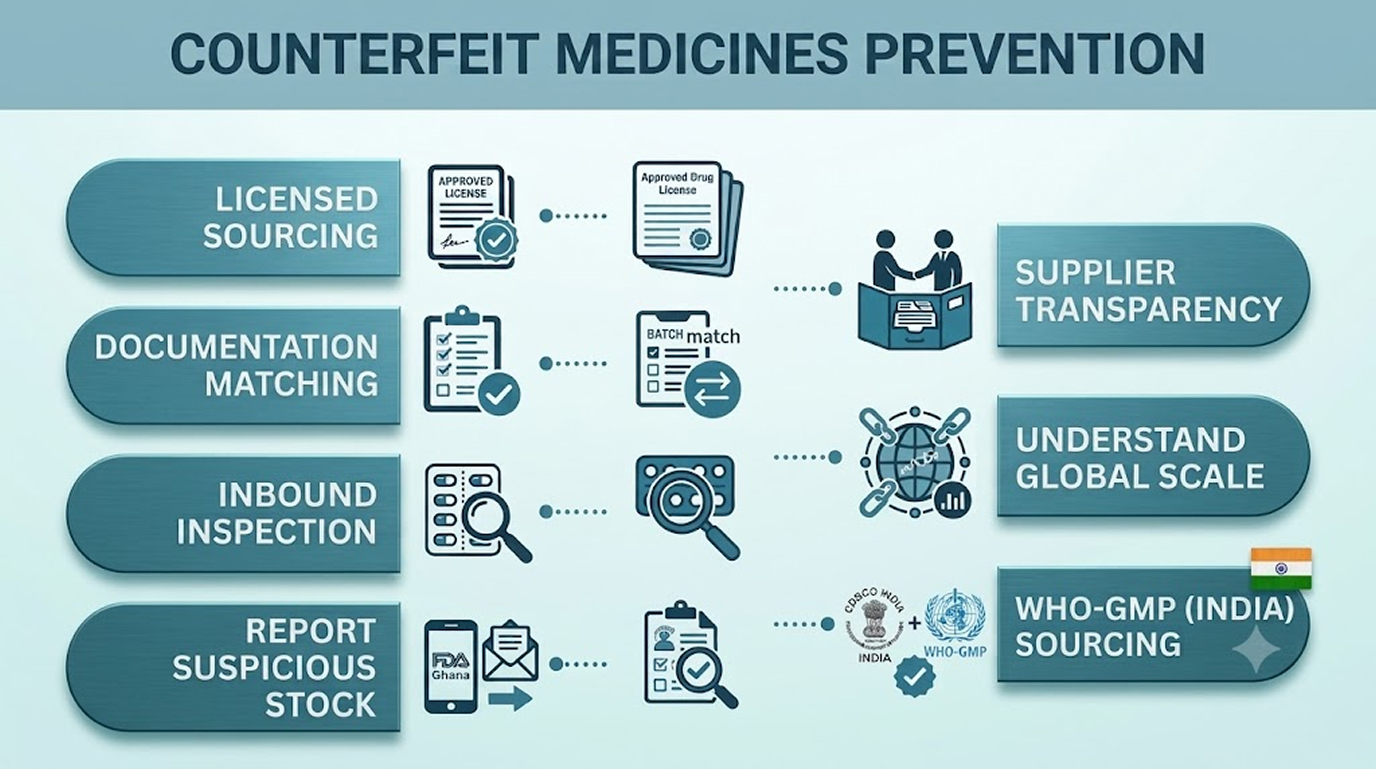
1. Buy Only Through Licensed, Documented Channels
Effective counterfeit medicines prevention begins with refusing to buy outside the regulated supply chain. Source exclusively from licensed exporters and wholesalers who supply from GMP-certified manufacturers, and insist on batch-wise Certificates of Analysis with every delivery. Street markets, unverified brokers, and “special deals” from unknown intermediaries are where falsified products live. If a supplier cannot produce a valid drug license on request, the conversation should end there.
2. Make Documentation Match the Product
Verify that batch numbers, manufacturing dates, and expiry dates printed on the physical stock match the Certificate of Analysis and packing list exactly. Counterfeiters can copy packaging with surprising accuracy, but they rarely maintain consistent paperwork trails. Keep records batch by batch so any product on your shelf can be traced back to its manufacturer within minutes, not days.
3. Inspect Every Consignment on Arrival
Train receiving staff as your first line of counterfeit medicines prevention. Every incoming consignment should be checked for printing quality, correct spelling, accurate pack sizes, intact security seals, uniform tablet appearance, and undamaged tamper-evident features. Compare new stock against previous genuine batches whenever possible — small inconsistencies are often the first sign of a problem.
4. Report Suspicious Stock Instead of Quietly Returning It
If anything looks off, report it to FDA Ghana rather than sending it back to the supplier without documentation. Quiet returns let falsified products re-enter circulation elsewhere. Reporting protects your own patients and pharmacies down the line, and it strengthens counterfeit medicines prevention efforts nationwide.
5. Choose Suppliers Who Invite Verification
A trustworthy supplier volunteers transparency rather than resisting it — licenses, manufacturer names, GMP certificates, and client references should be offered upfront, not extracted after repeated requests. This willingness to be checked is itself a strong signal of legitimacy.
6. Understand the Global Scale of the Problem
The World Health Organization estimates that substandard and falsified medical products are a significant public health threat, particularly in low- and middle-income countries. Understanding this scale reinforces why counterfeit medicines prevention cannot be treated as optional due diligence — it is a frontline patient safety measure.
7. Partner With Suppliers Who Source From CDSCO-Licensed, WHO-GMP Manufacturers
Divy Tradelink sources its pharmaceutical exports exclusively from Indian manufacturers licensed by the Central Drugs Standard Control Organisation (CDSCO) and certified under WHO-GMP or equivalent standards, backed by full documentation including proforma invoices, packing lists, and certificates of origin. See how our sourcing and documentation process works to understand what supports counterfeit medicines prevention at every step. Counterfeiters depend on buyers who don’t check. Be the buyer who always does.